Ways People Kept Personal Records Before Family Albums
Ways people kept personal records preserve the voices and stories behind letters, notebooks, and keepsakes, with simple ways to leave useful context.
The common mistake with personal records is saving a letter or keepsake without noting why it mattered. Later, the handwriting may be familiar but the occasion forgotten, and an object may outlast every explanation of its use. Ways people kept personal records can offer a modest remedy: preserve a few telling words, then leave enough context for another reader to understand them.
Letters, commonplace books, and object notes each hold a different kind of memory. None needs to become a complete family history. Choose the form that fits what you want to remember, and keep the record with care appropriate to its condition and material.
Choose a form that preserves what matters
A letter carries a voice and a relationship. A commonplace book gathers passages, recipes, observations, and sketches that someone wanted to keep close. A note beside an object can explain its maker, use, or place in a household.
- Letters: Keep correspondence that reveals a distinctive voice, exchange, or decision. Retain the envelope if its address or postmark adds context.
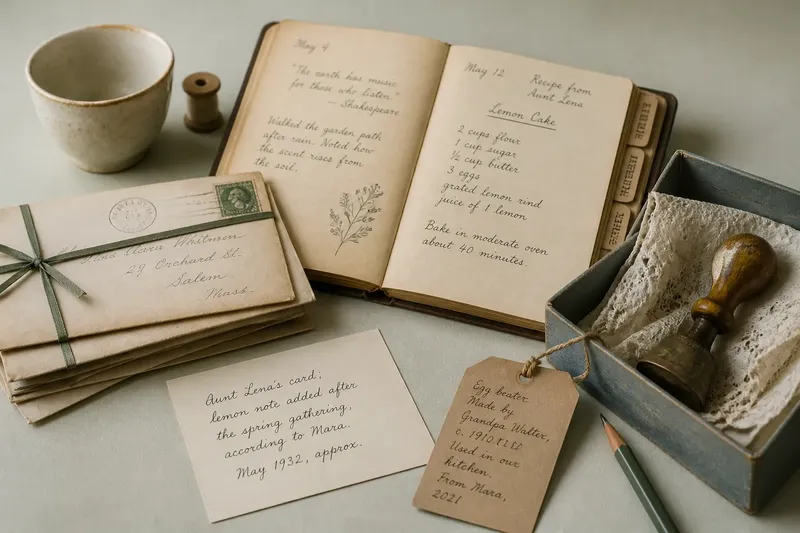
- Commonplace books: Gather copied passages, remembered sayings, recipes, or observations. Mark sources when known and distinguish copied words from the keeper’s comments.
- Object notes: Record the name, known owner or maker, use, and story of a tool, handmade item, or souvenir.
- Brief event notes: Note who visited, what was made, or what changed when no letter or object would preserve the moment.
It is not worth keeping every scrap on the chance that it may someday matter. Prefer records that preserve a voice, a choice, a relationship, or information that would otherwise be lost. A short note with a clear connection can be more useful than a pile of unidentified papers.
Write down what a future reader cannot infer
Start with what is known: a date or approximate season, the people involved, and the reason the item was kept. Use names and relationships rather than private shorthand when practical. If a detail is uncertain, say so plainly instead of turning a guess into family history.
For a useful note, include the detail that links the record to a particular moment. “Mara sent this after the move” gives a reader a lead; “nice letter” does not. For an object, note what can be observed separately from what someone remembers about it.
Imagine you have an unmarked recipe card in Aunt Lena’s handwriting, and a relative remembers that she added lemon after making the dish for a spring gathering. You write “Aunt Lena’s card; lemon note added after the spring gathering, according to Mara,” then place the card in a paper folder with a brief description. The resulting record identifies the handwriting, preserves the source of the memory, and avoids claiming more than anyone knows.
Keep a commonplace book readable without making it formal
A commonplace book can remain a mixed collection. Date entries where possible, leave a margin for later notes, and add a small index for names or subjects that recur. An index lets a reader find “garden” or “Lena” without rearranging the original pages.
Use quotation marks for copied passages and identify the writer or source when known. Put your own response beside the passage, not inside it. For recipes and instructions, note who shared them and whether the wording was copied or changed. These distinctions let a reader see what was borrowed, remembered, or added later.
Store letters and objects according to their condition
Storage advice depends on the item and its state. Clean, sturdy household paper may be kept in a folder or box that supports it without crowding. Fragile, brittle, damp, moldy, or unusually valuable material needs individual advice before it is handled, cleaned, labeled, or moved; ask an archivist or conservator when the stakes or condition make that appropriate.
Keep paper away from direct sunlight, damp areas, and household spills. For an object, avoid writing on its surface or attaching a label if that could cause damage. A separate paper tag or note placed nearby may be safer, but the right method depends on the material and finish. Do not assume that a particular pencil, adhesive, sleeve, or box suits every item.
When a letter belongs with an envelope or a group of related correspondence, keep those pieces together if their condition allows. Add a simple folder note identifying the people and any known gaps. For objects, keep the note close enough to stay connected without forcing it onto the object itself.
How can personal records stay clear and findable?
What belongs on a keepsake note?
Write the object’s name, known owner or maker, its use or significance, and who supplied the information. Mark dates and origins as approximate when they are not certain.
Should every family letter be kept?
Give priority to letters that preserve a voice, relationship, decision, or detail not recorded elsewhere. If the choice is unclear, set the letter aside with its context intact and review it later rather than deciding in haste.
How can I organize a commonplace book without rewriting it?
Keep its original sequence, add dates where known, and use a brief index for recurring names or subjects. This preserves how the book accumulated while making particular entries easier to find.
What should I do when an object’s story is unknown?
Describe what you can see, such as its markings, material, and where it was found, without guessing at its purpose or owner. Add that the history is unknown so a later reader can distinguish observation from family memory.
Leave a small map of the collection
A record becomes easier to use when its location is part of the record. Keep a plain inventory of which notebook, folder, or box holds particular names or groups of items. If relatives keep different parts of a collection, note who has what, with their agreement.
- Check whether a letter has a name or relationship attached; if it does, keep that note with it, and if not, record what is known before storing it.
- Check whether a date is exact or remembered approximately; if exact, copy it as written, and if uncertain, mark it as approximate.
- Check whether an object can safely take a tag; if its surface is sturdy and suitable, use an appropriate separate tag, and if not, place a note nearby.
- Check whether copied words have a known source; if they do, name it, and if not, mark the source as unknown rather than attributing the passage.
- Check whether related papers are separated; if their condition permits, group them with a folder note, and if not, record their relationship in the inventory.
- Check whether an item is fragile, damaged, or valuable; if so, pause routine handling and seek qualified preservation advice, and if not, use simple storage suited to its material.
Ways people kept personal records did not depend on making every object explain itself. A letter, notebook, or keepsake needs only a few honest clues beside it: who or what it concerns, what is known, and where its story continues. That small map can spare a future reader from confusing a useful fragment with an unexplained one.